
What Is BMI? How to Calculate Body Mass Index & Healthy Weight Range
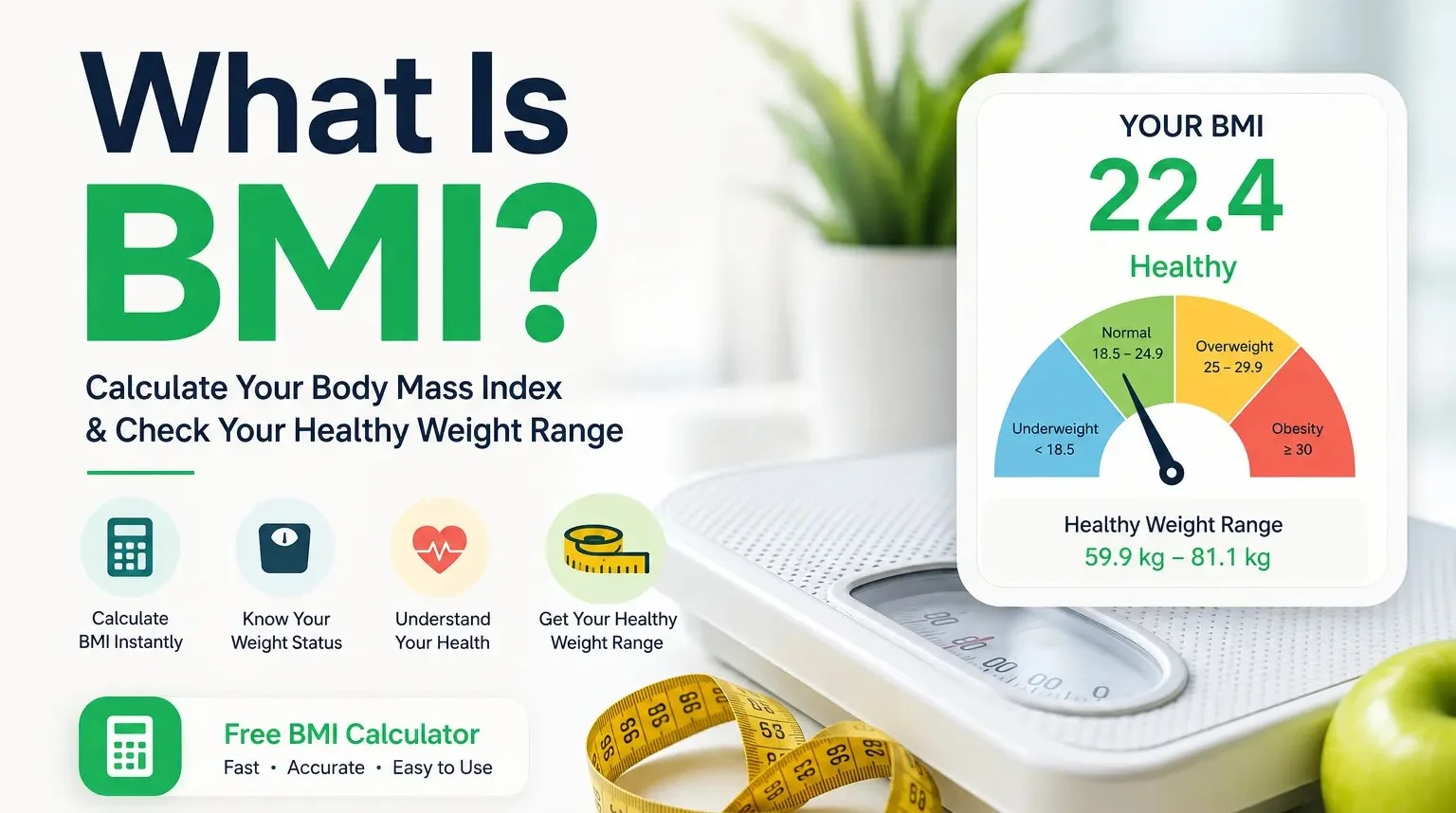
What Is BMI? A Complete Guide to Body Mass Index
Have you ever wondered whether your weight is healthy for your height? Many people judge their health by simply looking in the mirror or checking the number on a weighing scale. However, weight alone doesn't tell the whole story. That's where Body Mass Index (BMI) comes in.
BMI is one of the simplest and most widely used methods to estimate whether a person's weight falls within a healthy range based on their height. Doctors, fitness trainers, nutritionists, and healthcare organizations around the world use BMI as a quick screening tool to identify whether someone may be underweight, at a healthy weight, overweight, or obese.
Although BMI isn't a perfect measurement, it provides a useful starting point for understanding your overall health. It can help you recognize potential health risks early and encourage healthier lifestyle choices before problems become serious.
If you're curious about your own BMI, you can instantly calculate it using the Kivixa BMI Calculator. The calculator works directly in your browser, gives accurate results in seconds, and even shows your healthy weight range without requiring any registration.
What Does BMI Stand For?
BMI stands for Body Mass Index. It is a numerical value calculated using your weight and height. Instead of measuring body fat directly, BMI estimates whether your body weight is appropriate for your height.
The concept was developed in the 19th century by Belgian mathematician Adolphe Quetelet and has since become one of the most commonly used health screening methods worldwide. Today, organizations such as the World Health Organization (WHO) and many national health agencies recommend BMI as a quick way to identify possible weight-related health concerns.
Because it only requires two measurements—your height and your weight—BMI is easy to calculate and accessible to almost everyone.
Why Is BMI Important?
Maintaining a healthy weight is about much more than appearance. Both being underweight and carrying excess body weight can increase the risk of developing various health conditions over time.
Your BMI offers a simple snapshot of whether your current weight may increase your chances of health problems. While it doesn't diagnose diseases, it acts as an early warning sign that further evaluation or lifestyle changes might be beneficial.
Healthcare professionals often use BMI during routine health checkups because it's quick, inexpensive, and backed by decades of medical research.
A healthy BMI is often associated with:
- Better heart health
- Lower risk of type 2 diabetes
- Reduced blood pressure problems
- Improved mobility and joint health
- Better overall quality of life
- Lower risk of certain chronic diseases
On the other hand, consistently falling outside the healthy BMI range may indicate that it's time to review your diet, physical activity, and overall lifestyle.
How Is BMI Calculated?
Calculating BMI is surprisingly straightforward. It uses your body weight in kilograms and your height in meters.
The standard BMI formula is:
BMI = Weight (kg) ÷ Height² (m²)
For example, imagine someone weighs 70 kilograms and is 1.75 meters tall.
BMI = 70 ÷ (1.75 × 1.75)
BMI = 22.86
A BMI of 22.86 falls within the healthy weight category.
If you don't want to perform the calculation manually, simply use the free BMI Calculator on Kivixa. Just enter your height and weight, and you'll receive your BMI instantly along with your weight category and healthy weight range.
BMI Categories Explained
Once your BMI has been calculated, it falls into one of several standard categories. These categories help determine whether your weight is considered healthy.
| BMI Range | Category |
|---|---|
| Below 18.5 | Underweight |
| 18.5 – 24.9 | Healthy Weight |
| 25.0 – 29.9 | Overweight |
| 30.0 and Above | Obesity |
These ranges are intended for most adults aged 18 years and older. Children and teenagers use different BMI charts because their bodies are still growing.
Underweight (BMI Below 18.5)
If your BMI falls below 18.5, it may indicate that your body weight is lower than recommended for your height. Some people naturally have a smaller body frame, but being significantly underweight can also result from poor nutrition, certain medical conditions, or high levels of physical activity.
Being underweight may increase the risk of:
- Weakened immune system
- Vitamin and mineral deficiencies
- Low energy levels
- Bone weakness and osteoporosis
- Reduced muscle mass
Healthy Weight (BMI 18.5–24.9)
A BMI within this range generally indicates that your body weight is appropriate for your height. People in this category tend to have a lower risk of developing many weight-related health conditions, especially when combined with regular exercise, balanced nutrition, quality sleep, and healthy lifestyle habits.
Remember that maintaining a healthy BMI isn't about achieving a perfect number—it's about supporting long-term health.
Overweight (BMI 25–29.9)
A BMI between 25 and 29.9 suggests that your body weight is higher than recommended. While being overweight doesn't automatically mean you're unhealthy, carrying excess weight over time can increase the likelihood of developing several chronic diseases.
Making gradual improvements to your diet and increasing daily physical activity can often help reduce BMI naturally.
Obesity (BMI 30 or Higher)
Obesity is associated with a significantly increased risk of serious health conditions, including heart disease, type 2 diabetes, stroke, sleep apnea, fatty liver disease, and certain cancers.
If your BMI falls into this category, it's worth discussing your overall health with a qualified healthcare professional. Even modest weight loss can produce meaningful improvements in blood pressure, cholesterol levels, and blood sugar control.
Who Should Use a BMI Calculator?
One of the reasons BMI remains so popular is its simplicity. Almost any adult can use a BMI calculator within seconds.
A BMI calculator is useful for:
- Adults monitoring their weight.
- People beginning a fitness journey.
- Individuals following a weight-loss plan.
- Gym members tracking progress.
- Students learning about health and nutrition.
- Healthcare professionals performing basic health assessments.
Whether your goal is to lose weight, gain healthy weight, or simply stay fit, regularly checking your BMI can help you monitor long-term progress.
Benefits of Using an Online BMI Calculator
Modern online BMI calculators make the entire process effortless. Instead of remembering formulas or doing manual calculations, you receive instant results with just a few inputs.
Using the Kivixa BMI Calculator offers several advantages:
- Instant BMI calculation.
- No downloads or sign-up required.
- Works on desktop and mobile devices.
- Displays your BMI category immediately.
- Shows your recommended healthy weight range.
- Provides accurate calculations using internationally accepted BMI standards.
- Runs securely in your browser without uploading your personal information.
For anyone who wants a quick and reliable way to check their body weight status, an online BMI calculator is one of the easiest health tools available.
Does BMI Measure Body Fat?
One of the biggest misconceptions about BMI is that it directly measures body fat. In reality, it doesn't. BMI is simply a mathematical calculation based on your height and weight. It cannot determine how much of your body is made up of fat, muscle, bone, or water.
For example, two people can have exactly the same BMI but very different body compositions. A professional athlete with a high amount of muscle may have the same BMI as someone who carries excess body fat, even though their overall health is very different.
This is why doctors often use BMI as an initial screening tool rather than a complete health assessment. If your BMI falls outside the healthy range, your healthcare provider may recommend additional tests such as waist circumference, body fat percentage, blood pressure, cholesterol levels, and blood sugar measurements.
Think of BMI as the first step in understanding your health—not the final answer.
Advantages of BMI
Despite its limitations, BMI continues to be one of the most widely used health indicators because it is simple, affordable, and supported by decades of research.
- Quick and easy to calculate.
- Requires only your height and weight.
- No expensive equipment needed.
- Recommended by healthcare organizations worldwide.
- Useful for identifying potential weight-related health risks.
- Helps monitor long-term weight changes.
- Suitable for most healthy adults.
Because of these benefits, BMI calculators are commonly used in hospitals, fitness centers, schools, and wellness programs across the world.
Limitations of BMI
Although BMI is useful, it isn't perfect. There are several situations where BMI may not accurately represent a person's health.
1. Athletes
Athletes often have more muscle mass than the average person. Since muscle weighs more than fat, many athletes have a BMI that falls into the overweight category even though they have very little body fat.
2. Older Adults
As people age, they naturally lose muscle mass. An older adult may have a normal BMI while carrying a higher percentage of body fat than a younger person with the same BMI.
3. Pregnant Women
BMI should not be used to assess weight during pregnancy because healthy weight gain is a normal part of fetal development.
4. Children and Teenagers
Children are still growing, so they use age- and sex-specific BMI percentile charts rather than adult BMI categories.
5. Different Body Types
Everyone has a different body structure. Some naturally have larger frames while others have smaller ones. BMI cannot account for these differences.
Because of these limitations, BMI should always be considered alongside other health indicators instead of being viewed as the only measure of health.
BMI vs Body Fat Percentage
People often confuse BMI with body fat percentage, but they measure completely different things.
| BMI | Body Fat Percentage |
|---|---|
| Uses height and weight. | Measures actual body fat. |
| Quick calculation. | Requires special equipment. |
| Simple screening tool. | More accurate body composition analysis. |
| Suitable for most adults. | Better for fitness tracking. |
If your goal is simply to know whether your weight is generally healthy, BMI is an excellent starting point. If you're tracking muscle gain or fat loss, measuring body fat percentage can provide more detailed insights.
Healthy Ways to Improve Your BMI
If your BMI falls outside the recommended range, don't panic. Small, consistent lifestyle changes are often much more effective than extreme diets or intense workout plans.
Eat a Balanced Diet
Focus on whole foods such as fruits, vegetables, whole grains, lean proteins, healthy fats, nuts, and seeds. Avoid relying heavily on sugary drinks, processed snacks, and fast food.
Stay Physically Active
Aim for at least 150 minutes of moderate physical activity each week. Walking, cycling, swimming, jogging, strength training, and yoga are all excellent choices.
Get Enough Sleep
Poor sleep can affect hormones that regulate hunger and metabolism. Most adults should aim for 7–9 hours of quality sleep every night.
Drink Plenty of Water
Proper hydration supports digestion, metabolism, and overall health. Drinking enough water can also help reduce unnecessary snacking caused by thirst.
Avoid Crash Diets
Rapid weight-loss programs often produce short-term results but are difficult to maintain. Sustainable lifestyle changes are much more effective for achieving and maintaining a healthy BMI.
How Often Should You Check Your BMI?
Your BMI doesn't need to be checked every day. Since body weight usually changes gradually, checking it once every few weeks or once a month is enough for most people.
If you're following a structured fitness or weight-loss program, monthly BMI tracking can help you monitor long-term progress without becoming obsessed with daily weight fluctuations.
Why Use the Kivixa BMI Calculator?
There are countless BMI calculators available online, but many are cluttered with advertisements, require sign-ups, or don't provide useful explanations.
The Kivixa BMI Calculator is designed to be simple, fast, and privacy-friendly.
- Free to use.
- Instant BMI calculation.
- Shows your BMI category.
- Displays your healthy weight range.
- Responsive on desktop and mobile.
- No registration required.
- No personal information is stored.
- Runs entirely inside your browser.
Whether you're starting a fitness journey, maintaining your current weight, or simply curious about your health, the Kivixa BMI Calculator makes checking your BMI quick and effortless.
Frequently Asked Questions (FAQs)
What is a good BMI?
For most adults, a BMI between 18.5 and 24.9 is considered a healthy weight range. However, your overall health also depends on factors like body fat percentage, muscle mass, age, diet, and physical activity.
Can BMI tell me how much body fat I have?
No. BMI does not measure body fat directly. It only compares your height and weight to estimate whether your weight falls within a healthy range. For a detailed body composition analysis, body fat percentage measurements are more accurate.
Is BMI accurate for everyone?
BMI works well for most adults, but it may not be accurate for athletes, bodybuilders, pregnant women, older adults, or growing children because it doesn't distinguish between muscle and fat.
Can I calculate BMI using pounds and feet?
Yes. Many modern BMI calculators, including the Kivixa BMI Calculator, support both Metric (kg/cm) and Imperial (lb/ft/in) units, allowing you to calculate your BMI regardless of the measurement system you use.
How often should I calculate my BMI?
For most people, checking BMI once every month is enough. If you're actively trying to lose or gain weight, checking it every few weeks can help you monitor your progress without focusing too much on daily weight changes.
Can BMI help with weight loss?
Yes. BMI provides a useful starting point for setting realistic health goals. Combined with regular exercise, a balanced diet, and healthy lifestyle habits, BMI can help you track your weight management journey over time.
What is the healthiest way to improve my BMI?
The best approach is to make gradual lifestyle improvements rather than relying on crash diets or extreme workouts. Eating nutritious foods, exercising regularly, getting enough sleep, managing stress, and staying hydrated can all contribute to maintaining a healthier BMI.
Final Thoughts
Your Body Mass Index is one of the easiest ways to understand whether your weight is generally appropriate for your height. While BMI isn't a perfect measurement and shouldn't replace professional medical advice, it remains one of the most trusted screening tools used around the world.
Whether your goal is to lose weight, gain healthy weight, improve your fitness, or simply keep track of your health, regularly monitoring your BMI can help you stay aware of your progress and motivate healthier lifestyle choices.
If you're looking for a fast, accurate, and privacy-friendly way to check your BMI, try the Kivixa BMI Calculator. Simply enter your height and weight to instantly calculate your Body Mass Index, view your BMI category, and discover your recommended healthy weight range. Everything runs securely inside your browser, so your information stays completely private.
Understanding your BMI is only the beginning of your health journey. Pair it with balanced nutrition, regular physical activity, good sleep, and routine medical checkups to build long-term healthy habits that support your overall well-being.